The 1894-95 Great Freeze and how Cocoa survived where most of north Florida didn't

December 28, 1894 and February 7, 1895: two waves of subfreezing weather that destroyed Florida's commercial citrus. North-central Florida's industry never recovered. Indian River groves around Cocoa took heavy damage but lived. The freeze remade the geography of Florida citrus.

Workers grading citrus at a Florida packing plant, the kind of fruit that the 1894-95 freeze nearly wiped out across the state.
Florida citrus grading work. The 1894-95 freeze destroyed roughly 95% of Florida's citrus crop and killed two-thirds of the bearing trees in the state's main growing belt. Library of Congress, FSA/OWI Collection

The 1894-95 Great Freeze remade Florida citrus. On December 28, 1894, a polar air mass pushed south to roughly 20°F in central Florida overnight. Trees lost their fruit but survived. On February 7, 1895, a second polar outbreak hit a state still recovering, with temperatures dropping below 18°F in north-central Florida and the warmer late-January sap that had begun to rise freezing inside the trees. The second wave killed the trees outright. Roughly 95% of the 1894-95 crop was lost, and an estimated two-thirds of Florida’s bearing trees were destroyed permanently.

The Cocoa-area groves on the Indian River took heavy fruit losses but a much lower percentage of tree kill, perhaps 40–60% depending on the specific grove. The lagoon’s thermal mass moderated the temperature drop by 4-8 degrees compared to interior Florida groves at the same latitude. Cocoa’s citrus economy survived the freeze, and for the next twenty years the Indian River region captured market share from the dead Ocala and Gainesville groves.

The 1894-95 freeze is the founding event of modern Florida citrus geography. Before the freeze, the heart of Florida citrus was north-central Florida, Alachua, Marion, Citrus, Sumter, and Putnam counties. After the freeze, the surviving industry moved south to Polk, Lake, Orange, Volusia, and the Indian River counties. Most of that movement was permanent.

December 28, 1894, the first wave

The first cold air mass arrived in Florida on Christmas Day 1894 and reached its peak intensity on the night of December 28-29. Weather Bureau records (the predecessor of the National Weather Service) documented temperatures in the citrus belt:

  • Jacksonville: 14°F
  • Gainesville: 18°F
  • Ocala: 20°F
  • Sanford: 22°F
  • Daytona: 24°F
  • Cocoa: 28°F (estimated; no permanent Weather Bureau station yet)
  • Fort Pierce: 30°F

The damage on December 28-29 was to fruit, not trees. Oranges and grapefruit on the trees froze solid; juice expanded inside the rind, the rind cracked, and the fruit became unsalable within a few days as the cell structure broke down. Growers reported their groves looking “as if dipped in molasses”, meaning the dead fruit was hanging from healthy-looking branches.

In Cocoa, the 28°F low produced significant fruit damage but the trees themselves were intact. Citrus trees can tolerate temperatures in the 28-32°F range for short periods without permanent injury; below 26°F sustained for hours, leaves and small branches die; below 22°F, large limbs and trunks can split. Cocoa’s December 1894 minimum did not reach the tree-killing threshold.

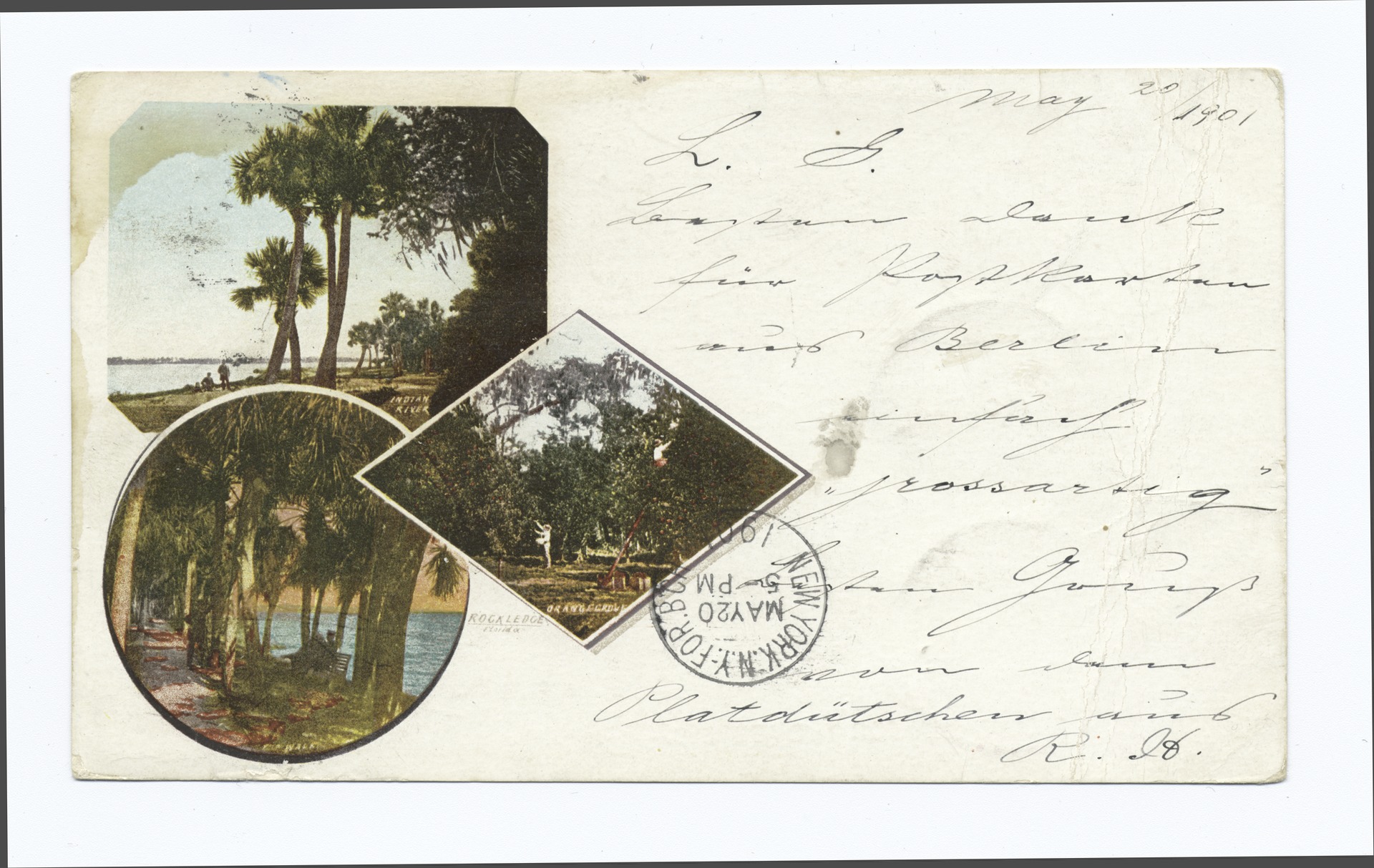
Orange grove walk near Rockledge, late 19th century, before the 1894-95 freeze.
A grove walk near Rockledge before the freeze. The mature canopy and ground-level shade in the photograph is what most of Brevard's groves lost over two December and February nights. New York Public Library Digital Collections (NYPL b12647398-62015). Public domain.

January and the false recovery

Late December 1894 and most of January 1895 were unusually warm in Florida. By late January, trees in the December-damaged groves had begun pushing new growth, what citrus growers call “winter flush.” Sap was rising. The trees that had survived December were vulnerable in a way they would not have been if cold weather had continued through January.

Growers across the state reported renewed optimism in late January. Newspaper accounts from the Florida Times-Union and the Ocala Banner described the rebound. Replanting plans for the destroyed fruit crop were already being made. The 1895 crop would be a partial one, but the industry would continue.

This was wrong, and the wrongness was in the trees’ physiology.

February 7, 1895, the second wave

The second polar air mass arrived in Florida on February 6-7, 1895. Temperatures dropped to roughly 18°F in north-central Florida, colder than December, and stayed below 22°F for an estimated 8-10 hours. Weather Bureau readings:

  • Jacksonville: 10°F
  • Gainesville: 14°F
  • Ocala: 16°F
  • Sanford: 18°F
  • Daytona: 22°F
  • Cocoa: estimated 24-26°F
  • Fort Pierce: estimated 28°F

In the December freeze, trees with no active sap flow had survived because frozen wood without water doesn’t expand much. In the February freeze, trees with rising sap had water inside the cambium and the bark layer. That water froze, expanded, and burst the cambium. Trees split vertically up the trunks. Large branches snapped under the ice load.

In the north-central Florida citrus belt, the February freeze killed an estimated 60-70% of all bearing trees outright. Many of the trees that did not die immediately died in the spring of 1895 from secondary infections entering the bark cracks.

In Cocoa, the February freeze still didn’t quite cross the tree-killing threshold for most groves. Estimates of permanent tree loss in the Indian River region range from 40% (Edward Porcher’s surviving operation, his article) to perhaps 60% (some Rockledge groves at slightly higher elevation, with less direct lagoon moderation).

Why the lagoon mattered

The Indian River Lagoon is a body of saltwater roughly 1-3 miles wide and 150 miles long, with an average depth of 4-5 feet. Saltwater has substantial thermal mass, it cools and warms slowly. In December and February 1894-95, the lagoon’s water temperature was probably in the high 50s to low 60s, much warmer than the air. Cold air passing over the lagoon picked up heat and moisture, reducing the air temperature drop in groves on the lagoon’s western shore (Cocoa, Rockledge, Eau Gallie) by an estimated 4-8 degrees compared to inland locations at the same latitude.

This is the founding observation of Indian River citrus geography. After 1895, growers and agricultural extension agents understood that proximity to the lagoon was a meaningful insurance policy against freeze. Acreage values on the lagoon’s western shore appreciated significantly post-1895 relative to interior locations.

Victory Groves Packing House, Rockledge, closest surviving structure to the post-freeze Cocoa packing era.
Victory Groves in Rockledge represents the surviving packing infrastructure. Cocoa shipped more fruit in 1899 than it had in 1894 because the freeze killed competition north of Daytona. Wikimedia Commons. CC.

What Cocoa did with the opportunity

The decade after the 1895 freeze was the boom era of Cocoa citrus. Acreage expanded as new growers (often relocated from frozen-out north Florida) bought land and replanted. Existing growers like Porcher consolidated holdings. Packing-house capacity grew. The Indian River brand premium emerged in the 1895-1910 period precisely because the surviving Indian River groves had a market that the dead north Florida groves couldn’t supply.

By 1910, Brevard County had roughly 5,500 acres of bearing citrus, up from perhaps 2,800 acres pre-freeze. The Cocoa-Rockledge corridor had become the densest concentration of citrus in the Indian River region.

The Florida East Coast Railway, which had reached Cocoa in 1893, was now the primary shipping artery for surviving Florida citrus, and the Cocoa packing houses were the principal Indian River shippers. The railroad’s reefer-car infrastructure expanded rapidly through the 1900s in response.

The freezes that followed

The 1894-95 freeze was not the last. Subsequent killing freezes in the Cocoa area:

  • February 1917, moderate freeze, significant fruit damage but limited tree kill.
  • January 1940, severe; perhaps 30% tree loss in some Brevard groves.
  • December 1962, the “Big Freeze,” killed roughly 40% of remaining Brevard citrus.
  • December 1983, paired with the December 1989 freeze, ended commercial citrus in Brevard.

Each freeze accelerated the consolidation south. By 1990, central-Florida citrus (Polk, Lake, Highlands counties) had become the heart of the industry, and the Indian River region had become a specialty fresh-fruit niche. By 2010, urban development had reduced Brevard County’s commercial citrus acreage to near zero (the packing house piece covers the consolidation in detail).

The Florida the 1894-95 freeze made

Without the 1894-95 freeze, Florida citrus would have remained concentrated in north-central Florida, where the labor force, the railroads, and the established markets were. The freeze pushed the industry south, and the post-freeze era is the period when the modern Florida citrus geography, central Florida processing, Indian River fresh fruit, scattered south Florida specialty groves, took shape.

Cocoa’s citrus economy from 1900 through the 1960s is, in a real sense, a creation of the 1894-95 freeze. Without it, the industry would not have moved south, the Indian River brand premium would not have existed, the Porcher fortune would have been smaller, and the buildings of Cocoa Village that citrus money built would not exist.

Sources

  • U.S. Weather Bureau, Florida observation records, December 1894 and February 1895 (predecessor of National Weather Service).
  • Florida Times-Union (Jacksonville), Ocala Banner, and Indian River Advocate (Titusville), contemporary freeze coverage, 1894-1895 (microfilm).
  • University of Florida, Institute of Food and Agricultural Sciences (UF/IFAS), Citrus Research and Education Center, historical analyses of Florida freezes.
  • Florida Department of Agriculture, citrus production statistics by county, 1885-1910.
  • Florida Historical Quarterly, articles on the 1894-95 freeze and its long-term effects.
  • USDA Yearbook of Agriculture, 1895 and 1896, Florida citrus reports.
  • Citrus Industry magazine, retrospective coverage of 19th-century Florida freezes.
  • NOAA National Centers for Environmental Information, historical climate data for Florida.