Cocoa and Rockledge: two cities that grew into each other but never merged

Rockledge incorporated in 1887, five years after Cocoa, and the two cities share a half-mile-long border on Eyster Boulevard. They have parallel histories, parallel economies, and a deliberate refusal to consolidate.

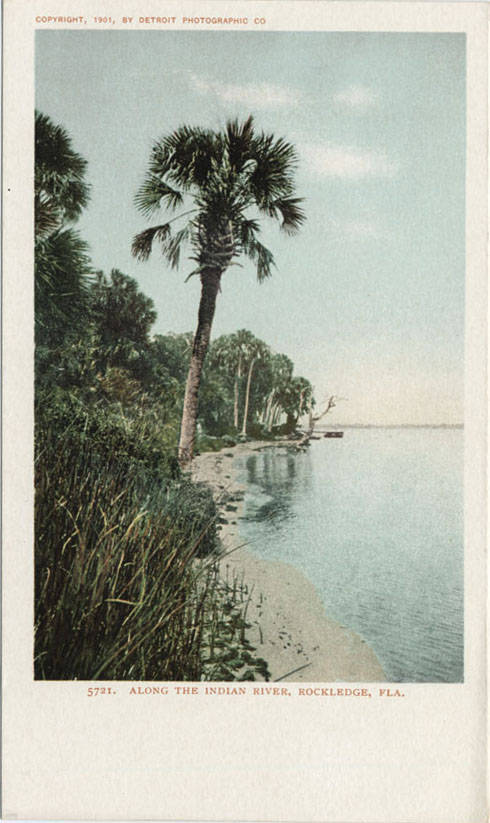
The Indian River at Rockledge, Florida, around 1900, the winter-colony era when Rockledge was briefly more famous than Cocoa.
Indian River at Rockledge, c. 1900. The winter-tourism era made Rockledge briefly more nationally known than its neighbor Cocoa. New York Public Library via Wikimedia Commons

Cocoa and Rockledge share a half-mile-long boundary along Eyster Boulevard and Rockledge Drive. Driving south from Cocoa Village on Riverside Drive, you cross from Cocoa into Rockledge at a moment most people don’t notice, the streetscape is continuous, the architecture is similar, the sidewalk on one side is in one city and the sidewalk on the other side is in the other. The two cities have parallel histories: both founded in the 1880s, both built on citrus, both with surviving Victorian-era historic districts. Rockledge incorporated on August 7, 1887, five years to the day after Cocoa’s August 7, 1882 incorporation.

They have not merged. There have been no serious consolidation proposals in the 138 years since Rockledge’s founding. The reasons go to Florida municipal-government incentives, distinct civic cultures, and the practical fact that two adjacent self-governing cities in Florida can stay separate as long as each provides services its residents want.

Why they were separate to begin with

Cocoa was founded as a citrus shipping town. The 1882 incorporation was driven by mainland farmers who needed wharf access, freight handling, and the political authority to negotiate with the railroad. Cocoa’s founding economic base was commercial.

Rockledge was founded as a winter-tourism town. The “Rockledge” name refers to the coquina rock ledge that runs along the lagoon shore at that latitude, geologically distinctive enough that Northern visitors built their estates there starting in the late 1870s. The Hotel Indian River (built 1887) and Hotel Rockledge (also 1880s) were national-scale resort hotels by the standards of the era. Rockledge’s founding base was hospitality and Northern winter residents.

The two economies overlapped, Rockledge grove owners shipped through Cocoa packing houses, Cocoa merchants supplied Rockledge hotels, but the civic cultures were distinct. Cocoa was Florida-founded; Rockledge was Northern-founded. The accent of the Rockledge winter-residents’ homes (cottage and shingle styles common in New England) is different from the Cocoa downtown commercial vernacular.

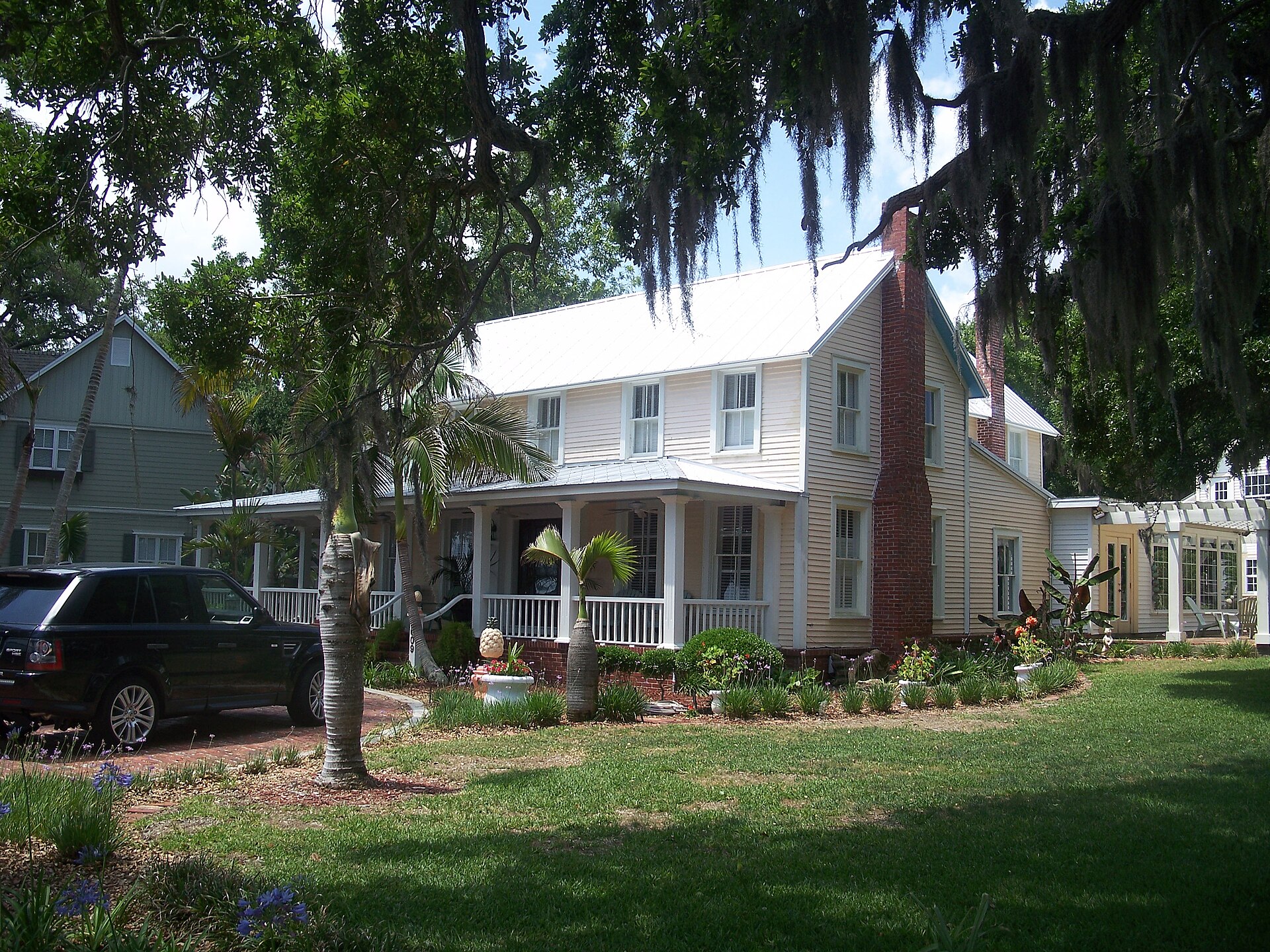
Magruder-Whaley House, Rockledge.
The Magruder-Whaley House in Rockledge, one of the surviving pre-1900 residences. The Magruder family also owned the Cocoa grove Edward Porcher arrived at in 1881. Ebyabe via Wikimedia Commons. CC BY-SA 3.0.

The Eyster Boulevard line

Eyster Boulevard is the formal north boundary of Rockledge and the formal south boundary of Cocoa. It runs east-west from US-1 to the Indian River, intersecting Riverside Drive about a half-mile south of Cocoa Village. The boundary was set in the original 1882 and 1887 incorporation petitions and has not moved.

A few city blocks of the lagoon-front strip on Rockledge Drive feel like a continuation of Cocoa Village, same scale of historic homes, same shade trees, same general feel. But they are administratively in Rockledge. Property tax goes to Rockledge. The Rockledge Police Department has jurisdiction. Garbage pickup runs on different days.

This kind of fine-grained boundary distinction is normal in older Florida cities. The state’s municipal-incorporation framework, dating to the 1885 constitution, encouraged small adjacent cities to incorporate separately rather than consolidate. Annexation through the 20th century was opportunistic and parcel-by-parcel rather than wholesale.

The 1894 county-seat fight, repeated

The same Cocoa-area political organizers who lost the 1894 county-seat fight (its own piece) periodically discussed consolidating with Rockledge through the early 20th century. The pitch was the standard pitch for municipal consolidation: combined tax base, eliminated duplication of services, larger voice in county and state affairs.

The pitch didn’t work. Rockledge residents, particularly the winter-colony class, viewed consolidation as dilution. The Rockledge identity was tied to the winter-residence culture, which depended on Rockledge remaining a distinct place with distinct character. Cocoa’s commercial-class boosters could see the upside of consolidation; Rockledge’s elite saw downside.

By 1920 the consolidation discussion had largely ended. The cities settled into long-term adjacent coexistence.

The 1925 land bust and parallel struggles

Both cities took the 1925 Florida land-boom collapse hard. Rockledge had been promoting itself nationally as a winter destination in competition with Palm Beach and Miami; the speculation in Rockledge real estate was substantial. Cocoa had less speculative real estate but its citrus packing economy was vulnerable to the broader Florida slump.

Both cities survived the bust because of their underlying economic bases, citrus for Cocoa, an aging but still-paying winter colony for Rockledge. Both cities did not grow significantly through the Great Depression. Both cities depended on World War II and the post-war boom (especially the Banana River Naval Air Station, which became Patrick Air Force Base, and then the NASA buildout) to break out of long Depression-era stagnation.

Post-WWII divergence

After World War II the two cities developed differently. Cocoa added US-1 commercial strip development north and south of downtown, large subdivisions to the west on what had been groveland, and a more diverse middle-class economy tied to NASA contracting and government employment. By 1970 Cocoa had a population of roughly 16,000.

Rockledge grew slower but in a higher-income direction. The historic winter-colony estates were subdivided into single-family lots that became upper-middle-class neighborhoods. Suntree, Viera, and other planned developments on what had been Rockledge-area grove land in the 1970s and 1980s pushed Rockledge’s population growth and its tax-base composition upmarket. By 2020 Rockledge had a population of roughly 27,000 and a higher per-capita income than Cocoa.

The cities’ downtown commercial districts also diverged. Cocoa Village (its own piece) became a tourism and restaurant district built on the 1986 NRHP listing. Rockledge has historic structures but never developed a comparably-focused commercial historic district; commercial development concentrated on Barton Boulevard, the modern US-1 strip, and the newer planned developments.

Rockledge High School building.
Rockledge High and Cocoa High split the same county school district. The two cities share roads, a hospital, and a sewage plant, but never merged. Wikimedia Commons. CC BY-SA.

The schools complication

School-district lines do not match city lines in Brevard County. Both Cocoa and Rockledge are served by Brevard Public Schools, the county-wide district. Cocoa High School draws students from both cities (and from parts of Merritt Island); Rockledge High School (founded 1965, opened on the current campus 1972) also draws from both, plus the Suntree and Viera suburbs.

This means residents of the two cities have functionally integrated schools, with the boundaries being attendance-area lines drawn by Brevard Public Schools rather than city lines. The 2008-2018 Cocoa High football dynasty drew players from both cities. Rockledge High has its own football program with its own state-championship runs (1989, 2003 in lower classifications).

What’s adjacent but separate today

Practical effects of two adjacent cities, not one:

  • Two police departments. Cocoa PD and Rockledge PD coordinate but don’t merge.
  • Two fire departments. Both contract with Brevard County for backup.
  • Two city halls. Cocoa’s is the 1939 building covered separately; Rockledge’s is a 1970s structure on Barton Boulevard.
  • Two sets of zoning rules. Subtle but real differences in development regulations.
  • Two property-tax millages. Modest difference, generally Rockledge slightly higher.
  • One Brevard County school district serving both.
  • One shared electrical utility (Florida Power & Light).
  • One shared water and sewer system (in most areas; some Rockledge-specific utility arrangements exist).

If you live in Cocoa and work in Rockledge, you cross a municipal boundary that has no practical visibility but real legal effect. Most residents don’t think about it. Both cities prefer it that way.

What might change

There is no current movement to consolidate the cities. The economic and political incentives that have kept them separate for 138 years are still in place. Florida municipal-government incentives still favor small independent cities. The civic cultures are still distinct, even if the cultural differences are smaller than they were in 1900.

The most likely future is continued adjacent coexistence, with continued shared services (schools, utilities) and continued separate municipal governments. The two cities have figured out how to be adjacent without being the same. That’s an accomplishment, not an oversight.

Sources

  • City of Cocoa, official municipal history and incorporation records.
  • City of Rockledge, official municipal history, 1887 incorporation records.
  • Brevard County Clerk of Court, municipal incorporation filings.
  • Cocoa Tribune and Indian River Advocate (Titusville), early-20th-century consolidation discussion coverage (microfilm).
  • National Register of Historic Places, Rockledge Historic District nomination materials.
  • Florida Historical Quarterly, articles on Brevard County municipal incorporation.
  • Brevard Public Schools, attendance-area maps and district history.
  • U.S. Census, decennial population data for Cocoa and Rockledge, 1900-2020.