Cocoa's citrus packing houses, 1890-1962: the rise, the freeze, and the consolidation

A.S. Dixon, the Cocoa Citrus Exchange, the Deer Park label, the Indian River brand premium, and the 1894-95 freeze that almost ended it all. Cocoa's citrus packing era ran for seventy years and built half the buildings still standing in Cocoa Village.

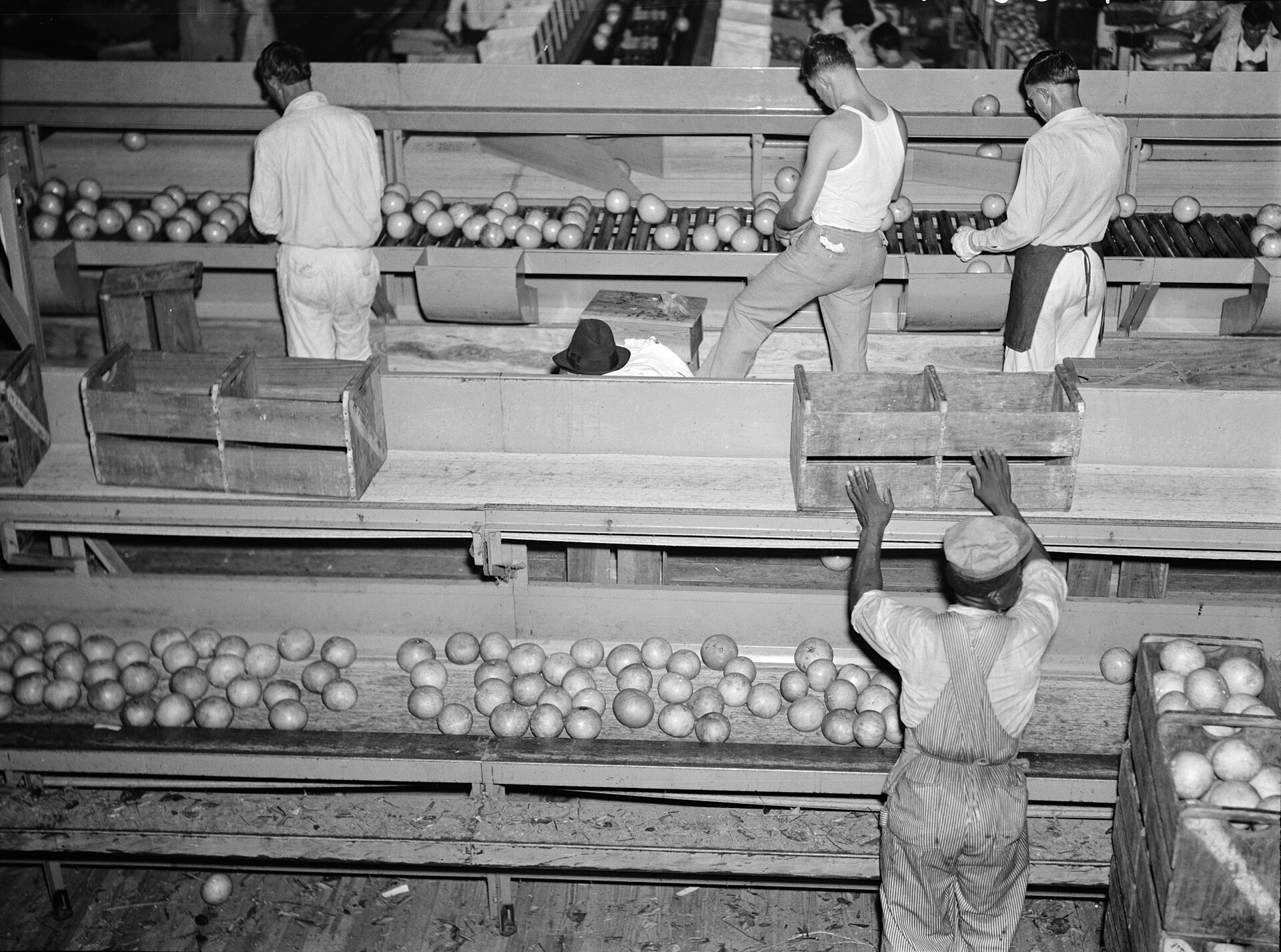
Workers grading citrus at a packing plant in Fort Pierce, Florida, period-correct illustration of the work that filled Cocoa-area packing houses through the 1950s.
Workers grading citrus at a Fort Pierce packing plant, FSA photograph. Cocoa's packing houses looked nearly identical and employed similar crews. Library of Congress, FSA/OWI Collection

Cocoa’s citrus packing era ran for roughly seventy years, from the late 1880s through the early 1960s. At peak (around 1925, before the land bust and the Mediterranean fruit fly quarantine), Brevard County’s Cocoa-Rockledge corridor had something like fifteen working citrus packing houses moving fruit north on the Florida East Coast Railway. By 1965 there were three. By 1985 there were none operating in Cocoa proper. What killed it: a combination of the 1962 freeze, urban encroachment, the consolidation of the Florida citrus industry into a few large processors, and the rise of frozen concentrate as the dominant Florida citrus product rather than fresh fruit.

The Cocoa packing houses left a physical legacy you can still walk through. The buildings on Florida Avenue and along the FEC right-of-way that today house antique stores, breweries, and a tile distributor were originally packing houses or fruit-cooling sheds. The architecture is recognizable: two stories, north-south alignment to catch prevailing breezes, large sliding doors on the rail side, a small office wing on the street side.

The Indian River brand

To understand Cocoa’s citrus economy, you have to understand the “Indian River” brand. Beginning around 1900, Florida citrus growers along the lagoon between Titusville and Stuart began marketing their fruit under the “Indian River” name, claiming the soils and microclimate produced sweeter, thinner-skinned oranges and grapefruit than interior Florida groves. The claim was partly real, partly marketing.

It was real because Indian River-area citrus genuinely matured later, ran higher in sugar, and had thinner skins (thinner skins meant they shipped less well, but presented better in northern markets). It was marketing because by 1930, “Indian River” had become a federally-defined geographic designation, the way “Champagne” works in France. The Indian River Citrus League, founded in 1931, actively defended the brand against interior Florida growers trying to use it.

For Cocoa packing houses, the Indian River premium was the difference between making money and not making it. Indian River grapefruit could sell for 30–40% more than equivalent fruit from Lake County or Polk County. Cocoa was inside the Indian River geographic boundary.

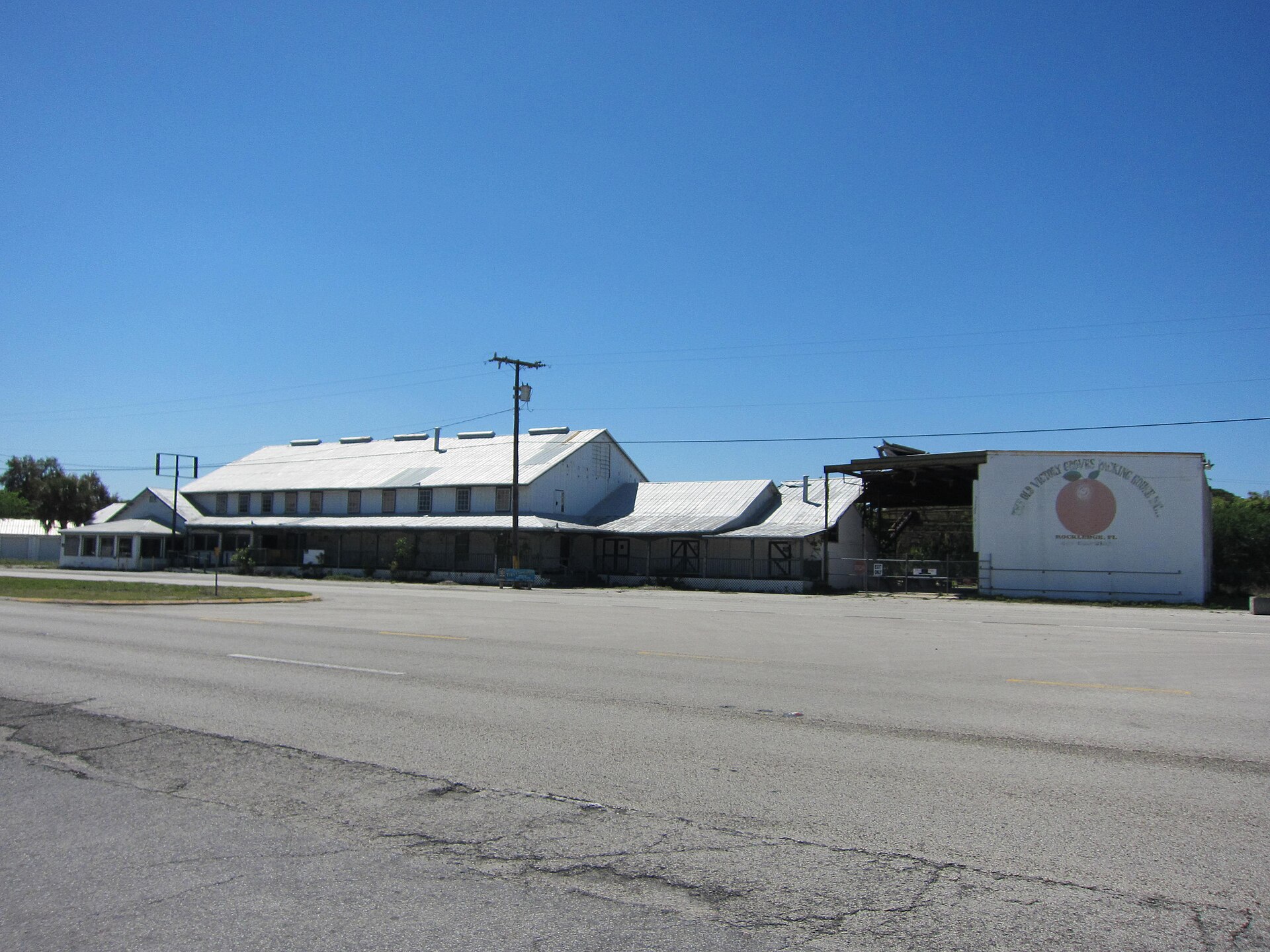
Victory Groves Packing House, Rockledge.
Victory Groves Packing House in neighboring Rockledge, the closest surviving structure to the Cocoa packing houses that ran along the FEC tracks from 1894 onward. Wikimedia Commons. CC.

The principal Cocoa houses, by name

A.S. Dixon Packing. Founded 1893 by Alpheus S. Dixon on Florida Avenue. One of the first dedicated packing operations in Brevard. Closed 1957, building demolished in the 1980s.

Indian River Fruit Company. Founded 1899, a partnership of several growers including E.P. Porcher (of Porcher House fame). Packed under the “Deer Park” brand. Merged into the Indian River Citrus Exchange in 1925.

Cocoa Citrus Exchange. A growers’ cooperative founded 1917 as the Cocoa branch of the Florida Citrus Exchange (the statewide cooperative). Operated a large packing facility north of downtown Cocoa adjacent to the FEC line. Survived through the 1962 freeze but closed in 1968 after fruit volume collapsed.

Magruder & Sons. A family operation, founded 1907, focused on grapefruit. The Magruders were one of Cocoa’s founding families (see the founding article). Operated through 1955.

Travis-Bishop Packing. A 1920s partnership between members of the Travis (of S.F. Travis Hardware) and Bishop families. Closed 1948.

Multiple smaller houses operated for shorter runs, Hayes Brothers, Indian River Selectfruit, Cocoa Cooperative, others, but the five named above account for roughly 80% of Cocoa’s citrus shipping volume between 1900 and 1955.

The freeze cycles that shaped everything

Cocoa’s citrus growers built their economy around three known freeze risks: light freezes (28°F or warmer, kill the bloom but not the tree), moderate freezes (24–27°F, kill the fruit but not the tree), and killing freezes (below 22°F sustained for hours, kill the tree to the ground).

The killing freezes in the Cocoa record:

  • February 1895, the second wave of the 1894–95 Great Freeze. Killed roughly 60% of Cocoa-area trees.
  • December 1962, the December 1962 freeze, sometimes called the “Big Freeze.” Killed roughly 40% of remaining Brevard citrus.
  • December 1983, the post-Cocoa-era freeze that ended Brevard County commercial citrus.
  • December 1989, finished off what the 1983 freeze had left.

Cocoa’s industry survived 1895 because the freeze damage was lighter on the lagoon than it was on the interior. Most of north Florida’s citrus belt (around present-day Gainesville and Ocala) moved south after 1895; the surviving Indian River growers picked up market share. Cocoa survived 1962 the same way, briefly. The 1983 and 1989 freezes coincided with the urban-development boom that was making it more profitable to sell grove land for housing than to replant, and by 1995 Brevard’s commercial citrus acreage was effectively gone.

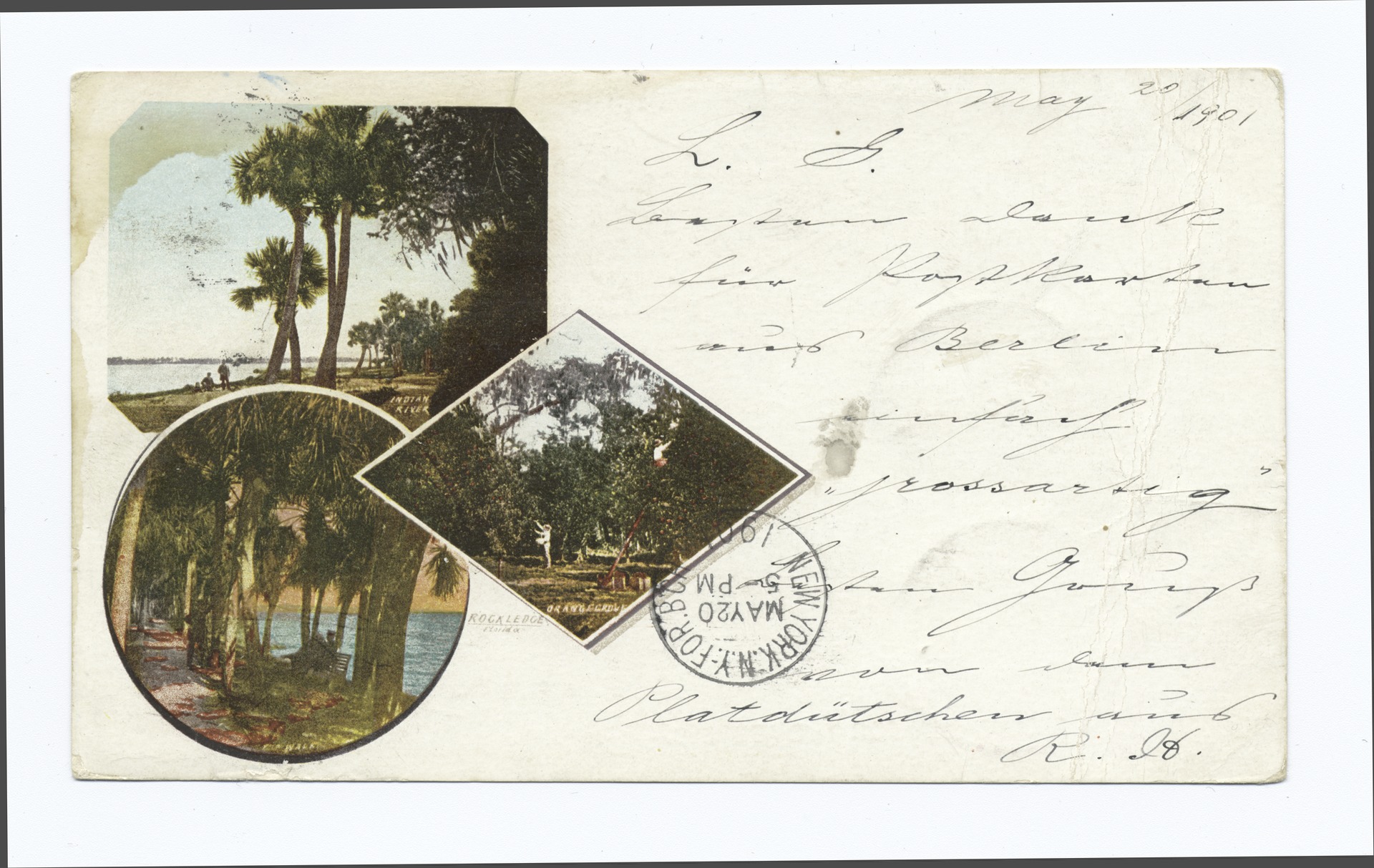
Orange grove walk near Rockledge, late 19th-century photograph.
A grove walk near Rockledge before the 1894-95 freeze. The packing houses moved south as the surviving grove operators moved south. New York Public Library Digital Collections (NYPL b12647398-62015). Public domain.

What a packing house actually did

A 1920s Cocoa packing house was a factory. Fruit arrived by mule-wagon from the grove (or, by the 1930s, by truck), unloaded onto a receiving belt, washed in a sequence of brushes and water sprays, sorted by hand-grading crews for size and quality, polished with carnauba wax, individually wrapped in tissue paper printed with the packer’s brand, and packed in wooden crates stenciled with the brand and the grade. Crates loaded onto FEC refrigerated cars at the rail spur. Northbound to Jacksonville, Atlanta, Washington, New York, Philadelphia, Chicago.

The labor was mostly Black, in the segregated South of 1910–1960, Florida citrus packing was one of the few year-round wage-paying industries open to Black workers, and the Cocoa packing houses’ grading and crating lines were staffed largely by Black women from the Black communities around Cocoa. Pay was piecework, roughly fifteen to twenty-five cents per crate packed, with experienced packers doing 200+ crates a day in peak season.

Peak season was October through May. June through September the packing houses ran skeleton crews on grove maintenance and equipment overhaul.

The Mediterranean fruit fly

In 1929, the Mediterranean fruit fly (Ceratitis capitata) was found in Florida groves. Federal quarantine followed: all Florida fruit had to pass inspection or sterilization treatment before leaving the state. The quarantine ran from 1929 to 1930 and again in 1956–1957 after a second outbreak.

Cocoa’s packing houses had to add inspection stations and sterilization (hot-water or fumigation) equipment. The capital cost favored the larger operations and accelerated the consolidation that was already happening. Several smaller packing houses didn’t make the investment and closed.

Why it ended

The textbook answer is the 1983 and 1989 freezes. The real answer is more complicated:

  • Urban land values by 1980 made grove land worth more as house lots than as bearing trees. A 10-acre grove that produced $5,000–$10,000 in fruit per year could sell as a subdivision for $200,000–$500,000.
  • Frozen concentrate (developed at the Florida Citrus Research Center in the 1940s, commercialized through the 1950s) shifted the industry to processing-grade fruit grown on enormous plantations in interior central Florida. Indian River fresh-fruit shipping became a specialty market, not a volume one.
  • Citrus canker and citrus greening (the latter still active) made it harder to maintain coastal groves cost-effectively.
  • The Pineda Causeway and barrier-island development made Brevard County’s economy about NASA, tourism, and retirement housing, not about citrus.

By 2000, Brevard County’s commercial citrus acreage was effectively zero. The packing houses are antique stores now.

Sources

  • University of Florida, Institute of Food and Agricultural Sciences (UF/IFAS), Citrus Research and Education Center, historic publications on Florida citrus production.
  • Florida Citrus Mutual, archives and annual statistical reports, 1935–present.
  • Florida Department of Agriculture and Consumer Services, citrus industry historical statistics.
  • USDA, Agricultural Marketing Service, Florida citrus shipment records, 1920–1970.
  • Cocoa Tribune and Florida Today (post-1966), citrus industry coverage.
  • National Register of Historic Places, Cocoa Village Historic District nomination, NRHP 86001245.
  • Florida Historical Society, Florida Historical Quarterly, Brevard citrus history articles.
  • Federal quarantine records, USDA Animal and Plant Health Inspection Service, Mediterranean fruit fly outbreaks 1929 and 1956.