Why Cocoa lost the Brevard County seat to Titusville in 1894

In 1894 a county-wide vote moved the Brevard County seat from Titusville to its current location, Titusville, again, after a brief Cocoa-adjacent interlude. Cocoa came close to becoming the county seat. It didn't, and that's a story about geography, railroad politics, and one specific election.

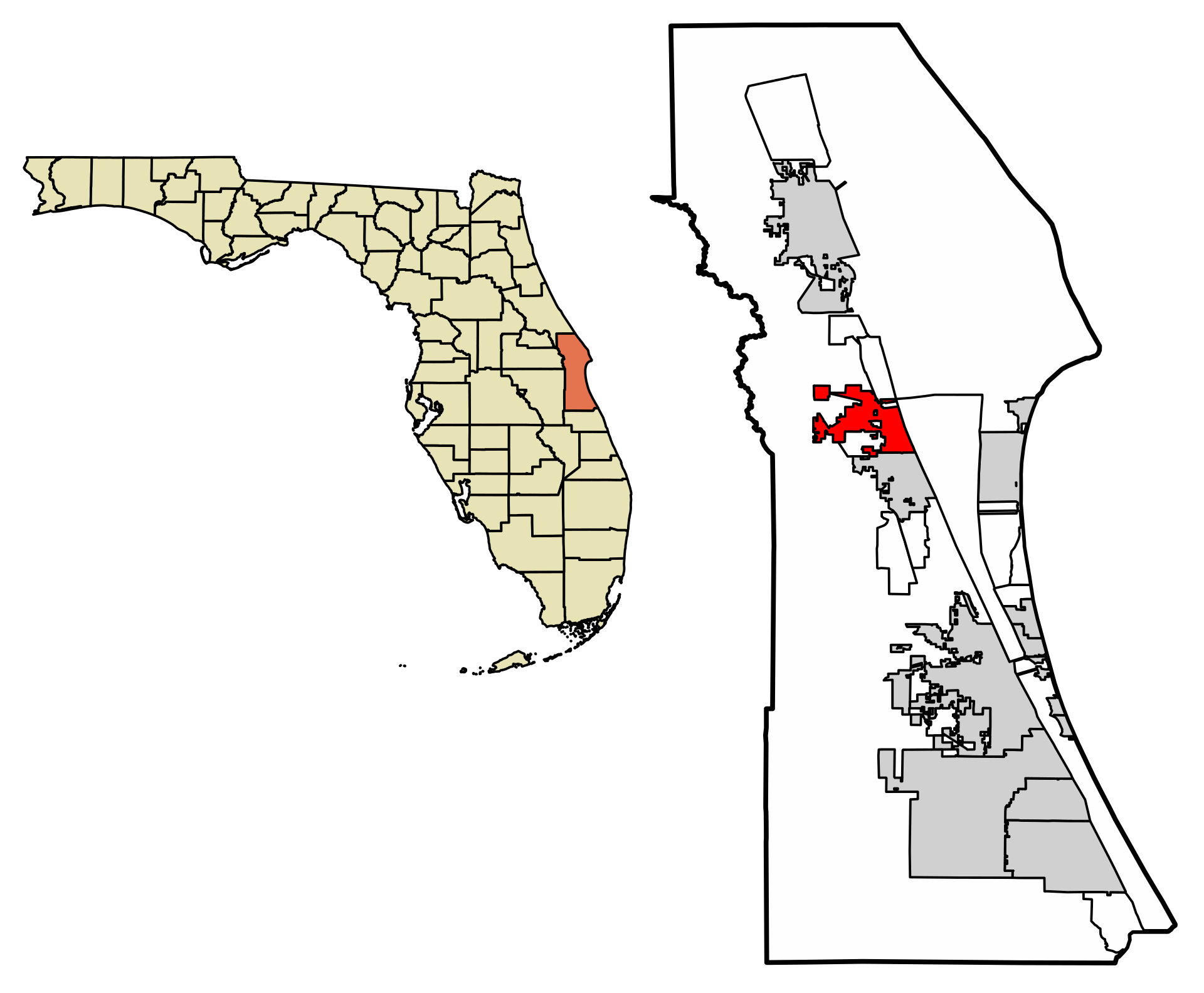
Map of Brevard County, Florida with the City of Cocoa highlighted.
Brevard County with Cocoa highlighted. Cocoa came close to becoming the county seat in the 1880s and 1890s. U.S. Census Bureau via Wikimedia Commons

Brevard County’s seat has been in Titusville for most of the county’s history, but there was a stretch in the late 1880s and early 1890s when Cocoa was a credible challenger. The 1894 election that settled the question was close enough to leave hard feelings for a generation. Cocoa lost partly because Titusville sat where Henry Flagler’s Florida East Coast Railway already had infrastructure, partly because Titusville’s political organization was tighter, and partly because the lawyers who would have to commute to court had families in Titusville.

The current Brevard County Courthouse in Titusville (the historic 1912 structure, with a 1979 main complex) is the third on the site. The original 1880s courthouse burned in 1912. None of the historic court buildings ever stood in Cocoa.

Brevard County before Cocoa was Cocoa

The Florida Legislature created Brevard County on January 6, 1855, splitting it from St. Lucie County. The county was named for Theodore Washington Brevard, the state’s antebellum comptroller. The original 1855 boundaries were enormous, Brevard then covered what is now most of central-east Florida, from roughly Daytona Beach south to the West Palm Beach area.

The original county seat was Susanna, a tiny settlement near present-day Fort Pierce. Susanna lost the seat to Sand Point (the original name for Titusville) in 1879. Titusville took its current name in 1873, named for railroad promoter Henry T. Titus.

In 1885 the Florida Legislature carved most of southern Brevard off into the new Dade County (later split further). The remaining Brevard County, smaller and more concentrated, had two real candidates for its seat: Titusville at the north end of the county, and Cocoa about 25 miles south.

The 1880s push

Through the 1880s, Cocoa boosters argued the county seat should move south. The argument was demographic. Cocoa was growing faster than Titusville, the citrus economy was concentrated in the Cocoa-Rockledge corridor, and the steamboat traffic on the Indian River made Cocoa more accessible to southern Brevard residents than Titusville was.

Cocoa’s case was led by Edward Porcher (covered in his own article), several of the Magruder family, and a handful of Rockledge merchants. The pitch was simple: move the seat to a more central location, build a new courthouse with bond money, attract the legal profession that follows courthouses.

A first county-seat removal petition reached the Florida Legislature in 1889. The Legislature, then as now reluctant to overrule local political organization, declined to act and referred the matter to a county-wide referendum.

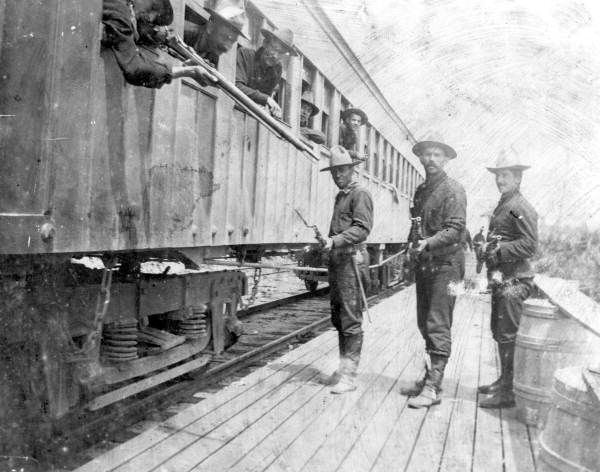
Louisiana Volunteers at the Cocoa train depot during the Spanish-American War mobilization, 1898.
Cocoa's train depot in 1898. The FEC made Cocoa the county's largest rail town within a decade, but the 1894 county-seat referendum had already put the courthouse in Titusville. State Library and Archives of Florida via Wikimedia Commons. Public domain.

The 1894 referendum

The referendum was held in late 1894. Per Brevard County Clerk of Court records (later reconstructed; the originals were lost in the 1912 courthouse fire), Titusville won by approximately 200 votes out of roughly 1,800 cast. The vote was close enough that Cocoa’s organizers immediately challenged it on procedural grounds, alleged registration irregularities in north Brevard, alleged ballot-handling problems, but the challenge failed.

What carried Titusville:

Railroad infrastructure. The Florida East Coast Railway had reached Titusville in 1885, eight years before it reached Cocoa. Titusville had a Flagler-built hotel, telegraph office, and depot. Court was nominally accessible by railroad from anywhere in the county; in practice, the lawyers were on the railroad.

The Titusville bar. By 1894 Titusville had a small but established legal community, five or six practicing attorneys, the county judge, the clerk of court, all with houses, families, and offices in Titusville. Moving the seat south would have meant either commuting from Titusville to Cocoa for trials or relocating practices. The lawyers voted, and they voted to stay.

Northern Brevard turnout. Titusville’s political organization, led by Henry Titus’s heirs and a handful of Republican-leaning merchants (Brevard was a Republican-leaning county in the late 19th century, an unusual pattern for the post-Reconstruction South), turned out a high percentage of northern Brevard voters. Cocoa’s organization was looser and produced thinner turnout in the southern precincts.

The Indian River bridge issue. There was no bridge across the Indian River at Cocoa until 1917 (its own piece). Reaching Cocoa from the Merritt Island and barrier-island precincts required a ferry. Titusville’s location, while geographically less central, was more practically accessible to north-county and Merritt-Island voters via the FEC Railway and the existing road network.

What Cocoa got instead

Losing the courthouse fight had a real cost. The Brevard County Courthouse construction in the 1880s and 1890s would have brought roughly $50,000 in construction spending plus the long-term economic anchor of a county legal community. Cocoa got none of that.

What Cocoa did get, partly as consolation and partly because the citrus economy was already concentrated there, was Brevard’s commercial center of gravity. By 1910 Cocoa was the largest city in the county by population (a position it held until the post-WWII NASA boom moved population growth to Titusville and the barrier-island communities). The bank, the major packing houses, the principal hotel, and most of the wholesale commerce was in Cocoa. The legal profession stayed in Titusville; everything else came to Cocoa.

The 1894 vote was also followed by a quieter compromise: Brevard County established a circuit court branch in Cocoa for civil-only matters, which operated from a rented building on Brevard Avenue from 1896 through about 1940. This wasn’t the courthouse, but it meant lawyers could file civil matters in Cocoa without traveling to Titusville. The arrangement was undocumented in formal county-organization records and existed by practice rather than statute.

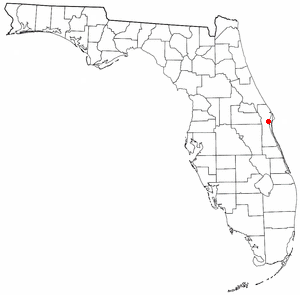
Florida outline map with Cocoa pinned.
Cocoa pinned on the state map. Brevard County stretches roughly 70 miles north-south along the lagoon, and the courthouse sits at the northern end. Wikimedia Commons. Public domain.

Subsequent attempts

Cocoa’s preservation organizations and merchant associations periodically revived the county-seat question through the 20th century. There were serious discussions in 1924 (during the land-boom era when Cocoa’s growth was at peak), in 1947 (during a post-war push for county-government modernization), and in the early 1980s (when the county-government complex needed expansion). None went anywhere.

The reason, by 1980, was structural: the modern Brevard County government complex in Titusville represented decades of accumulated investment, and moving it would have cost tens of millions of dollars for no clear benefit to anyone outside Cocoa. The 1894 fight had been close. By 1980 it wasn’t close anymore.

The 1912 fire and what survived

The original 1880s Brevard County Courthouse in Titusville burned to the ground in 1912. The fire destroyed most of the county’s pre-1912 records, including the original 1894 election certificates and many of the 19th-century deed registrations. What survives of the 1894 county-seat fight is mostly contemporary newspaper coverage (Indian River Advocate in Titusville, Cocoa Tribune once it began publishing in 1908, Florida Times-Union in Jacksonville for state-level coverage) and the secondary reconstructions in 20th-century county histories.

The 1912 replacement courthouse, a two-story brick Beaux-Arts building, still stands and is listed on the National Register. The current main county complex dates to 1979 and is functional rather than historic.

What if Cocoa had won

If the 1894 vote had gone the other way by 200 votes, Cocoa would have had a Brevard County Courthouse built somewhere on Delannoy Avenue or Brevard Avenue in the late 1890s. The legal profession would have followed. The citrus economy might have integrated more tightly with the legal infrastructure (citrus shipping contracts, grove deed work). The 1912 fire would have happened in Cocoa instead of Titusville.

The barrier-island community, when it developed in the 1920s, would have been politically tied to a Cocoa-centered county government rather than a Titusville-centered one. Cocoa Beach’s relationship to the mainland would look different.

This is counterfactual. What actually happened was that Cocoa became the commercial capital of Brevard County while Titusville stayed the political capital. The arrangement worked, mostly. The 1894 vote settled it.

Sources

  • Brevard County Clerk of Court, election records (partially reconstructed post-1912 fire), 1894 county-seat referendum.
  • Florida Legislature, Brevard County boundary acts, 1855 (creation) and 1885 (Dade County split).
  • Indian River Advocate (Titusville), 1894 election coverage (microfilm via University of Florida Digital Collections).
  • Florida Times-Union, statewide political coverage of Brevard county-seat fight, 1893-1895.
  • William T. Cash, History of Florida from its Discovery by Ponce de Leon in 1513, vol. 2 (1938), Brevard County chapter.
  • Florida Historical Quarterly, articles on Reconstruction-era and post-Reconstruction Florida county-seat fights.
  • National Register of Historic Places, registration form for 1912 Brevard County Courthouse, NRHP reference 80000986, listed 1980.
  • Florida Master Site File, Florida Division of Historical Resources.